

Digital Marketing Agency in Ludhiana
Digital Marketing Agency in Ludhiana

From 1 October 2026, Meta has started charging for service messages on the WhatsApp Business Platform in India — replies that have been free since November 2024.
More urgently: Meta has said it will stop delivering service messages entirely for any business that did not have a payment method registered by 30 September.
Here’s what actually changed, who it affects, and what it costs.
Most of the panic around this is misplaced, so start here.
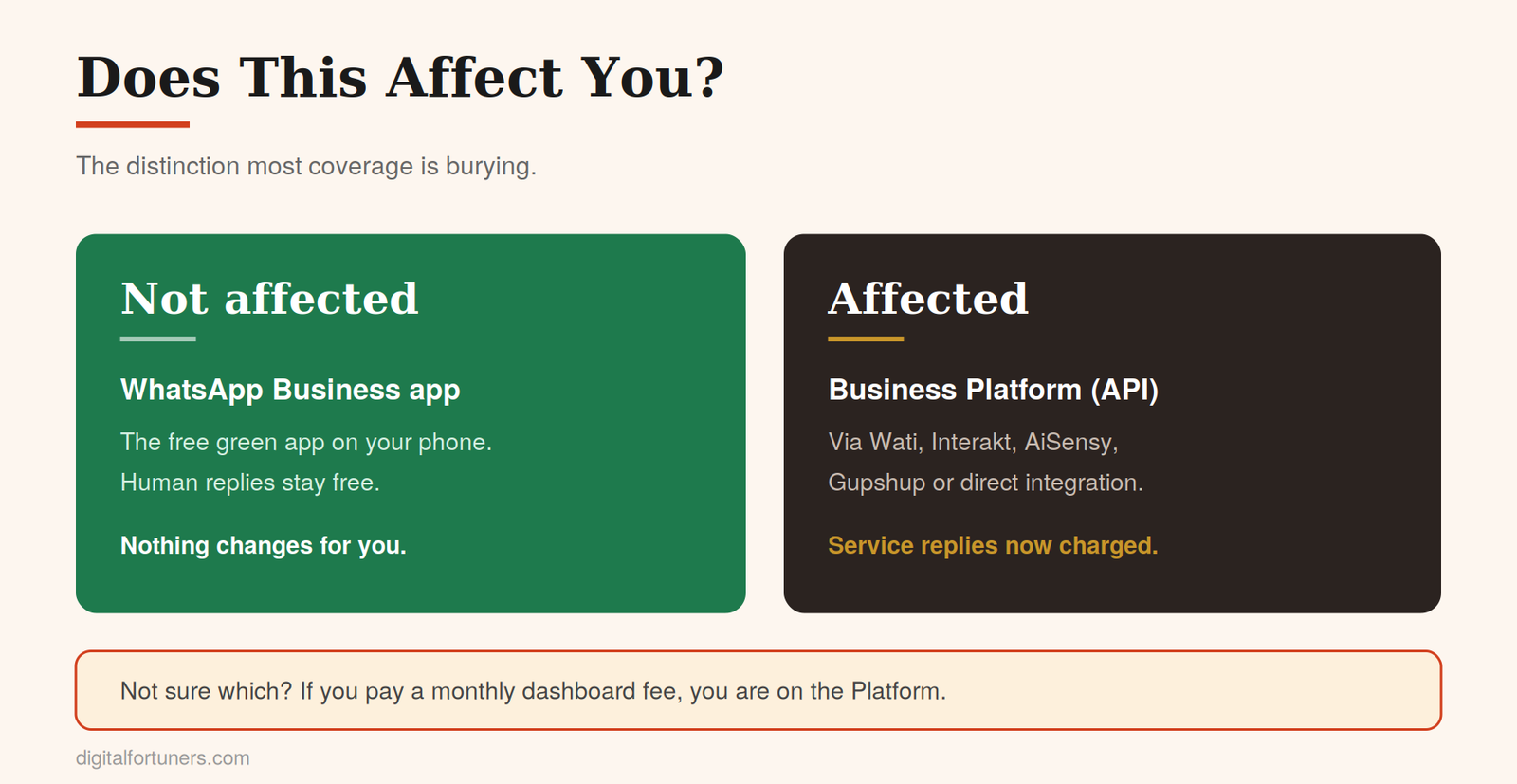
Not affected: The free WhatsApp Business app — the one you download from the Play Store and reply from on your phone. Human replies typed in that app remain free. If this is how you handle customer messages, nothing changes for you.
Affected: The WhatsApp Business Platform (API) — used by businesses sending at scale, usually through a solution provider like Wati, Interakt, AiSensy, Gupshup or Twilio, or integrated directly.
If you don’t know which you’re on: if you log in through a dashboard you pay a monthly fee for, you’re on the Platform. If you reply from the green WhatsApp Business app on your phone, you’re not.
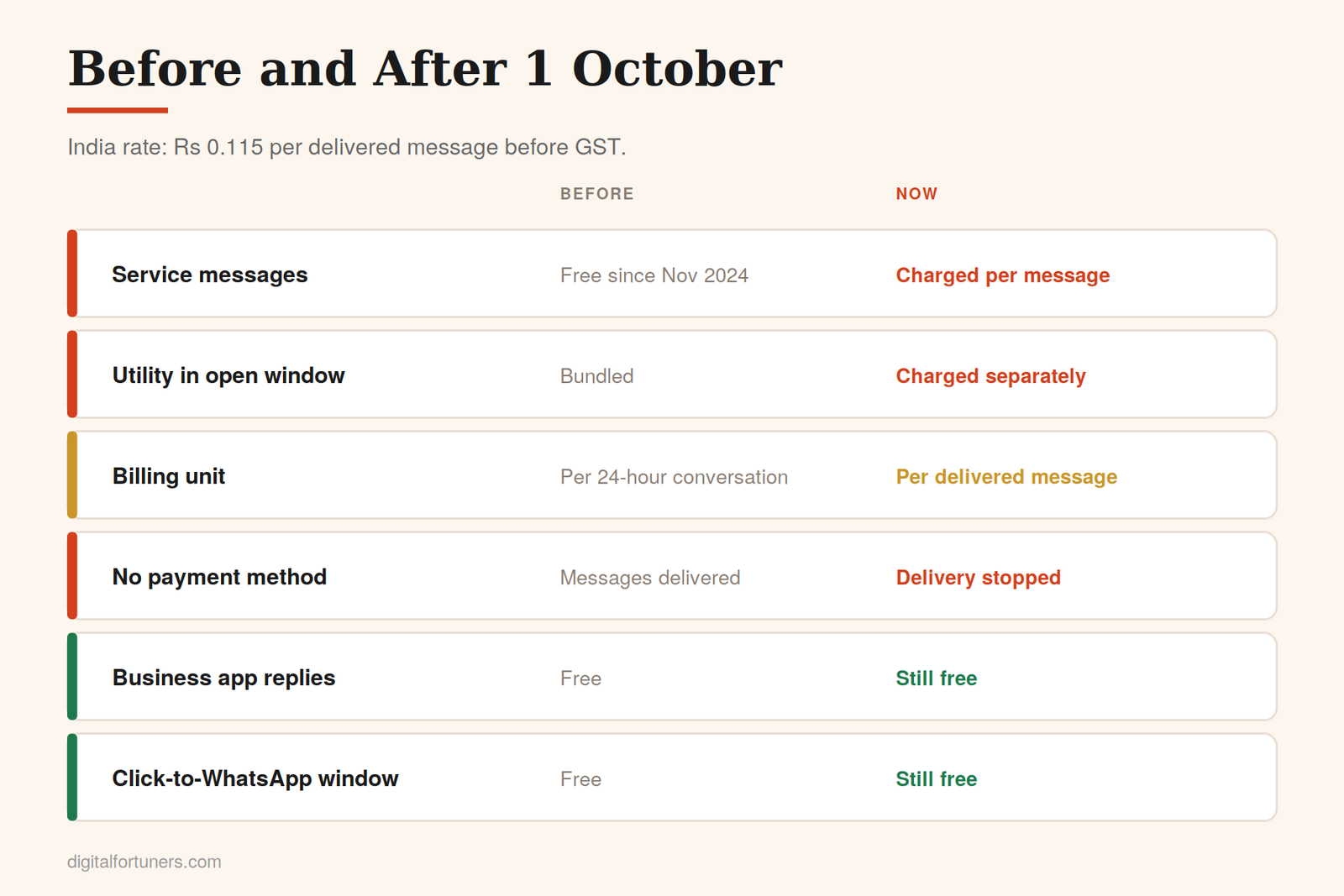
Service messages are now charged. A service message is a free-text reply sent inside the 24-hour customer service window — the window that opens when a customer messages you. These have been free since 1 November 2024. They are now billed per delivered message.
Utility messages inside the window are now charged too. Previously these were treated differently when sent within an open service window.
Charges apply per delivered message, not per conversation. This is the structural change. The old model billed per 24-hour conversation. The new one bills each message that lands.
Meta stops delivery without a payment method. In Meta’s own wording: for any solution provider or directly-integrated business without a payment method on file by 30 September 2026, Meta will stop delivering service messages from the point charging begins on 1 October.
₹0.115 per delivered message before GST for utility, authentication and service messages. Marketing messages are charged at a higher rate.
Business Standard reports a free allowance of 1,000 service replies per phone number per month before charges begin — which means most small businesses handling modest volumes will see little or no change to their bill.
Where it adds up is multi-message conversations. Under the old structure, a conversation containing one marketing message, two Meta Business Agent responses, one service reply and one utility message incurred a single charge. Under the new structure, that same conversation triggers five.
Two things that remain free:
One thing billed separately: messages generated by Meta Business Agent carry their own token-based AI charges on top.
1. Check your payment method today. If you’re on the Platform and have no card or payment method registered, your service messages are not being delivered right now. This is the only genuinely urgent item on this list.
2. Ask your solution provider how they’re handling it. If you use Wati, Interakt, AiSensy or similar, the billing relationship may sit with them. Get written confirmation of who is charged and how it appears on your invoice.
3. Count your monthly service replies. Under roughly 1,000 per number per month and the impact is minimal. Well above it and you need to model the new cost before it arrives as a surprise.
4. Audit your automation for message bloat. Per-message billing punishes chatty flows. A bot that sends four short messages where one would do now costs four times as much. Consolidate.
5. Reconsider AI-generated replies. Meta Business Agent messages carry both a message charge and a token charge. Worth checking whether the volume justifies it.
This is the second significant tightening of WhatsApp Business economics this year. In January, Meta banned general-purpose AI chatbots from the Platform. Now the free replies are gone.
The direction is consistent: WhatsApp is becoming a paid channel with real unit economics, not a free one. For businesses that built customer service entirely on free API replies, the cost base has moved.
Two practical consequences:
Owned channels matter more. Email, SMS and your own website carry no per-message fee to a platform. A channel you rent can reprice; one you own cannot.
Conversation design is now a cost decision. Every unnecessary message has a price attached. Flows built when replies were free are now carrying an avoidable bill — the same logic that applies to any automation you build on WhatsApp.
For most small businesses in Ludhiana and Punjab running a handful of conversations a day through the free Business app, none of this applies. For anyone running the Platform at volume, the maths has changed and is worth recalculating this week.